Ati Radeon Hd 3000 Graphics Drivers For Mac
Mac Pro (Late 2013) AMD FirePro D300 AMD FirePro D500 AMD FirePro D700: 4.1. Mac Pro (Mid 2012) ATI Radeon HD 5770 ATI Radeon HD 5870. I just successfully installed AMD's 14.4 64bit Display Drivers for Windows 7 and 8.1 on Windows 10 Tech Preview. I only installed the Display Driver and Catalyst Control Center, incase anyone is wondering if it will work. With my AMD 3400M APU with Radeon HD 6520G Graphics, and I have no problem with the drivers or Control.
Contents. Architecture This article is about all products under the 'Radeon HD 3000 Series'. All products of this series contain a GPU which implements. Video acceleration The (UVD) is present on the of the GPUs used in the HD 2400 and the HD 2600 but not of the HD 2900. The HD 2900 introduced the ability to decode video within the 3D engine. This approach also exonerates the from doing these computations, but consumes considerably more electric current.
Desktop products. Main article: Radeon HD 3800 The Radeon HD 3800 series was based on the codenamed RV670 GPU, packed 666 million transistors on a 55 nm fabrication process and had a die size at 192 mm 2, with the same 64 shader clusters as the R600 core, but the memory bus width was reduced to 256 bits. The RV670 GPU is also the base of the stream processor, which uses the GPU to perform which were done in the CPU previously. The Radeon HD 3850 and 3870 became available mid-November 2007. Radeon HD 3690/3830 The Radeon HD 3690, which was limited only to the Chinese market where it was named HD 3830, has the same core as the Radeon 3800 series but with only a 128-bit memory controller and 256 MiB of GDDR3 memory. All other hardware specifications are retained. A further announcement was made that there would be a Radeon HD 3830 variant bearing the same features as Radeon HD 3690, but with a unique device ID that does not allow add-in card partners in China to re-enable the burnt-out portion of the GPU core for more memory bandwidth.
Av rooms for mac. TSP can plan and execute an audio/video integration strategy that allows organizations to take advantage of new trends in teleworking and remote work. Already have an existing video conference room system? Use Zoom's Conference Room Connector to extend your standards-based conference systems to the. Communications team. Overall Guidelines for All Conference Rooms. All rooms have built-in computers, either PC or Mac with Microsoft Office Suite installed. We curate our AV brands for conference rooms based on performance, reliability. To your laptop PC or MAC, or by using the user-friendly app for iPhone, iPad,. Room EQ Wizard REW, free room acoustics software and audio measurement software. MacOS DMG (35.3MB, includes private Java 8 JRE). BetterTouchTool, Moom. For 10.14 Mojave use the latest V5.20 beta version from AV Nirvana.
The Radeon HD 3690 was released early February 2008 for the Chinese market only. Radeon HD 3870 X2.
Radeon HD 3870 X2 Radeon HD 3870 X2 (codenamed R680) was released on January 28, 2008, featuring 2 RV670 cores with a maximum of 1 GiB GDDR3 SDRAM, targeting the enthusiast market and replacing the Radeon HD 2900 XT. The processor achieved a peak single-precision floating point performance of 1.06 TFLOPS, being the world's first single-PCB graphics product breaking the 1 TFLOP mark. The Radeon HD 3870 X2 uses the same approach for communications between the two GPU cores as the Sapphire Radeon X1950 Pro Dual and Radeon HD 2600 X2. The GPU cores communicate to each other through an onboard PCI-E switch, providing each core with ×8 (Radeon X1950 Pro Dual) to ×16 (Radeon HD 2600 X2) PCI-E bandwidth and becoming a software CrossFire setup, supporting two extra hardware CrossFire bridges. The Radeon HD 3870 X2 uses PEX8547 PCI-E switch, but each core shares ×16 PCI-E bandwidth. The card only sees one CrossFire bridge being placed onboard and between the cores, thus only allowing one CrossFire bridge to be plugged onto the card. AMD stated the possibility of supporting 4 Radeon HD 3870 X2 cards, allowing 8 GPUs to be used on several motherboards, including the MSI K9A2 Platinum and, because these motherboards have sufficient spaces between PCI-E slots for dual-slot cooler video cards, presumably as a combination of two separate hardware CrossFire setups with a software CrossFire setup bridging the two, but currently with no driver support.
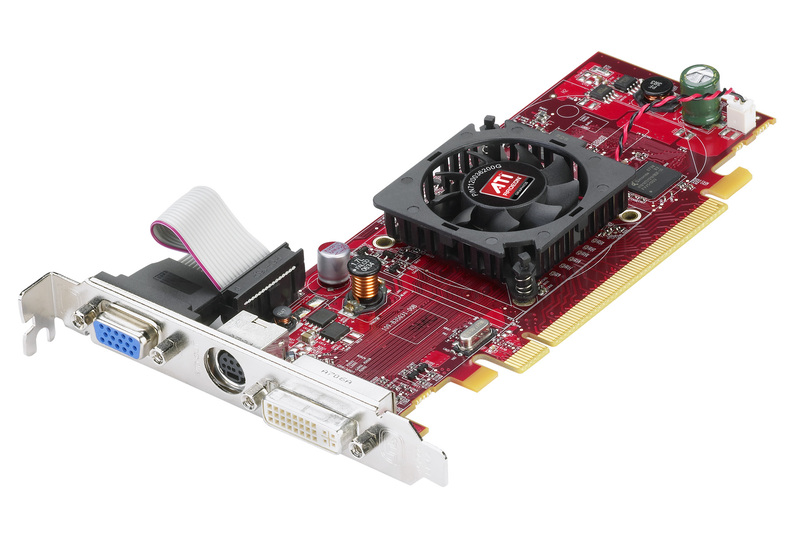
Radeon HD 3600 The Radeon HD 3600 series was based on the codenamed RV635 GPU, packed 378 million transistors on 55 nm fabrication process, and had 128-bit memory bus width. The support for HDMI and D-sub ports is also achieved through separate dongles. Beside the DisplayPort implementations, there also exists other display output layouts as dual DVI port or DVI with D-sub display output layout. The only variant, the Radeon HD 3650, was released on January 23, 2008 and has also an AGP slot with 64-bit bus width or the standard PCI-E slot with 128-bit.
Radeon HD 3400. Main article: All Mobility Radeon HD 2000/3000 series share the same feature set support as their desktop counterparts, as well as the addition of the battery-conserving 7.0 features, which are augmented from the previous generation's PowerPlay 6.0. The Mobility Radeon HD 2300 is a budget product which includes UVD in silica but lacks unified shader architecture and 10.0/ 4.0 support, limiting support to 9.0c/SM 3.0 using the more traditional architecture of the previous generation. A high-end variant, the Mobility Radeon HD 2700, with higher core and memory frequencies than the Mobility Radeon HD 2600, was released in mid-December 2007. The Mobility Radeon HD 2400 is offered in two model variants; the standard HD 2400 and the HD 2400 XT. The Mobility Radeon HD 2600 is also available in the same two flavors; the plain HD 2600 and, at the top of the mobility lineup, the HD 2600 XT. The half-generation update treatment had also applied to mobile products.
Announced prior to 2008 was the Mobility Radeon HD 3000 series. Released in the first quarter of 2008, the Mobility Radeon HD 3000 series consisted of two families, the Mobility Radeon HD 3400 series and the Mobility Radeon HD 3600 series. The Mobility Radeon HD 3600 series also featured the industry's first implementation of on-board 128-bit GDDR4 memory. About the time of late March to early April, 2008, AMD renewed the device ID list on its website with the inclusion of Mobility Radeon HD 3850 X2 and Mobility Radeon HD 3870 X2 and their respective device IDs. Later in Spring 2008 held in Shanghai, a development board of the Mobility Radeon HD 3870 X2 was demonstrated alongside a platform demonstration system. The Mobility Radeon HD 3870 X2 was based on two M88 GPUs with the addition of a PCI Express switch chip on a single PCB.
The demonstrated development board is on PCI Express 2.0 ×16 bus, while the final product is expected to be on AXIOM/ modules. Radeon Feature Matrix The following table shows features of Radeon-branded GPU microarchitectures.
The Radeon 100 Series has programmable pixel shaders, but do not fully comply with DirectX 8 or Pixel Shader 1.0. See article on. These series do not fully comply with OpenGL 2+ as the hardware does not support all types of non power of two (NPOT) textures. OpenGL 4+ compliance requires supporting FP64 shaders and these are emulated on some TeraScale chips using 32-bit hardware. ^ The UVD and VCE were replaced by the Video Core Next (VCN) ASIC in the APU implementation of Vega. ^ To play protected video content, it also requires card, operating system, driver, and application support.
A compatible HDCP display is also needed for this. HDCP is mandatory for the output of certain audio formats, placing additional constraints on the multimedia setup. More displays may be supported with native connections, or splitting the maximum resolution between multiple monitors with active converters. ^ DRM is a component of the Linux kernel. Support in this table refers to the most current version. Graphics device drivers AMD's proprietary graphics device driver 'Catalyst'. Main article: AMD Catalyst is being developed for.
As of July 2014, other operating systems are not officially supported. This may be different for the brand, which is based on identical hardware but features OpenGL-certified graphics device drivers. AMD Catalyst supports of course all features advertised for the Radeon brand. The Radeon HD 3000 series has been transitioned to legacy support, where drivers will be updated only to fix bugs instead of being optimized for new applications.
Free and open-source graphics device driver 'Radeon'. Main article: The free and open-source drivers are primarily developed on and for Linux, but have been ported to other operating systems as well.
Each driver is composed out of five parts:. Linux kernel component. Linux kernel component: basically the device driver for the. user-space component libDRM. user-space component in;. a special and distinct 2D graphics device driver for, which if finally about to be replaced by The free and open-source 'Radeon' graphics driver supports most of the features implemented into the Radeon line of GPUs.
They are not reverse engineered, but based on documentation released by AMD. See also., the GPGPU version of Radeon HD 3870 graphics card References. Retrieved 2018-04-21. Retrieved 2018-04-22. Retrieved 2018-04-20., retrieved January 30, 2007., retrieved December 7, 2007 October 11, 2007, at the., retrieved January 22, 2008 December 8, 2007, at the., retrieved January 30, 2008., retrieved November 27, 2007 November 17, 2007, at the., retrieved January 23, 2008. (in Japanese), retrieved January 23, 2008. 2010-04-02 at the.
And 2010-02-09 at the. 2010-03-05 at the. And 2010-02-11 at the. 2010-06-19 at the., retrieved April 8, 2008. ^ Killian, Zak (22 March 2017).
Retrieved 23 March 2017. Radeon Technologies Group (AMD). 13 June 2017. Larabel, Michael (7 December 2016). Retrieved 7 December 2016.
Retrieved 2014-07-06. Archived from on 2013-07-16. External links.
Editor's note: The furor about why Apple is deprecating OpenGL has flared up again with the release of Mojave. This piece originally ran in June, but remains accurate and relevant today Apple's list of Mac hardware supporting the new macOS Mojave is identical to its list of. More specifically, Metal is Apple's hardware-accelerated 3D graphics and compute framework, standard library and GPU shading language. Mojave will require at least a Late 2012 iMac or Mac mini, or a Mid 2012 MacBook Air or MacBook Pro. It also of course runs on any new 2017 iMac Pro or new Retina MacBooks (released in 2015), and supports all of the black cylinder Mac Pros (released since 2013). It also supports the earlier 'cheese grater' Mac Pro models back to Mid 2010, if equipped with a Metal-capable graphics card. Why Mojave requires a Metal-capable GPU Lack of support for Metal graphics is why some of the Macs that are supported in today's macOS High Sierra can't be upgraded to run Mojave.
This includes 2009-2011 ('non slim') iMacs; 2010-2011 Mac minis; 2009-2010 plastic non-Retina MacBooks; and 2011 or earlier non-Retina MacBook Pro and MacBook Air models. The new Mojave drops support for a couple years of non-Retina models, but still supports some non-Retina Macs, as the problem isn't their display resolution but rather their GPU capabilities. Older Mac Pro models dating back to 2010 can be outfitted with new Metal-capable GPUs to run the new release, making it clear Apple isn't just dropping legacy machines to force new purchases. Drawing a line at Metal-capable GPUs allows Apple to optimize graphics performance-particularly for entirely new software features including multi-user FaceTime and other new iOS-familiar UI features.
If you've owned a Mac for 8-9 years, Mojave offers a good reason to upgrade your hardware and join the modern Metal party. The new Mojave release will officially ship this fall alongside a new iOS 12, watchOS 5 and the new tvOS, following what has been Apple's regular schedule for OS updates for several years now. In advance of this, Apple is offering a program where users can opt in to download prerelease software, test out its new features in advance and report any bugs they discover to Apple. Metal replaces OpenGL Metal was first delivered in 2014 for the previous year's iPhone 5s to of the graphics capabilities of its custom A7 'System on a Chip,' which bundled a 64-bit CPU and independent GPU. The performance gains from Metal come largely from its optimizations to reduce CPU load, enabling software to much more efficiently make use of the power of the GPU.
Metal achieves this using explicit synchronization and shared memory space between GPU and CPU; lower driver overhead, precomputed shaders and up-front state validation; and efficient multithreading, where every CPU thread can send commands to the GPU. Metal gets its name from its low level of hardware optimization, as it runs on 'the bare metal,' rather than hovering over a large hardware abstraction layer in the model of cross platform graphics frameworks like OpenGL, which were designed to support a wide range of processors. Apple initially moved to OpenGL in the late 90s after Steve Jobs announced plans to, an early project to build support for software graphics rendering into the Mac. At the time, moving to OpenGL allowed Apple to take advantage of existing work already done to build software that enabled hardware acceleration on a variety of different GPUs. Fifteen years later, however, Apple's iOS had become the largest platform of uniform mobile hardware. In parallel with Metal, Apple launched the first 64-bit custom-ARM CPU, and was also optimizing the generic GPU design created by Imagination Technologies. Going forward, Apple knew that all of its iOS devices would get a 64-bit CPU and an advanced GPU.
Outside of iOS, Android and Windows Mobile licensees were using a wide variety of processors and graphics hardware. They were fated to be years behind in 64-bit CPUs and were with cost effective 'value engineering' that required devices to ship with underperforming graphics. Developing the State of the Art in mobile GPUs was an expensive and risky proposition that had pushed one-time mobile GPU giants AMD, Texas Instruments and Nvidia.
Apple's goal for iOS was to build extremely high performance graphics capable of rapidly ratcheting up performance and then just as rapidly scaling it down to conserve battery life. It needed the ability to optimize support for upcoming products-notably the higher resolutions of iPhone 6 and 6 Plus, and future models of iPad that would demand more graphics power than most PC laptops had. Android and Windows licensees had far less ambitious plans. Samsung introduced new high resolution panels but shipped these with basic GPUs running standard Android software.
The focus was on bragging specifications, not on actual usability or performance in gaming, creative or computationally intensive software. In 2015 Apple brought Metal support to recent Macs (with GPUs dating back to 2012, including Intel's HD 4000 and Iris Graphics; AMD's Graphics Core Next GPUs; and Nvidia's Kepler-based GPUs) in macOS El Capitan. Metal 2 focuses on the ML, AR, VR future Last year, Apple announced Metal 2 for macOS High Sierra, with improvements including a new shader debugger and GPU dependency viewer for more efficient profiling and debugging in Xcode; support for accelerating the computationally-intensive task of training neural networks, including machine learning; lower CPU workloads via GPU-controlled pipelines, where the GPU is able to construct its own rendering commands and schedule them with little to no CPU interaction; and support for Virtual Reality.
Metal 2 is also supported in iOS on devices using the new: iPhone 8, 8 Plus, and X models. This chip also launched Apple's first independent, even more tightly optimized for not just accelerating graphics but also accelerating machine learning and Augmented Reality (which includes applications such as VR and face tracking). Apple is no longer trying to work within a commodity-graphics community where its own product is just a proprietary variant of an Intel PC, outfitted with one of a several proprietary GPU designs that must all be abstracted to look similar to developers trying to make use of them. Today, Apple is building its own highly customized silicon-including its own CPU, GPU and Neural Engine, and has to develop bare Metal software to run these both efficiently and at their maximum capacity. Android and other platforms have begun supporting a community-developed Vulkan framework for graphics that makes improvements over the 1990's era OpenGL, but they don't share the same attainable goals as Apple.
Most Android makers are focused on high volume sales of basic phone devices that sell on average for around $200. The OpenGL deprecation Earlier this month, Apple's developer documentation that active development has ceased for OpenGL and OpenCL on the Mac, and that the APIs will only get 'minor changes' going forward. 'Apps built using OpenGL and OpenCL will continue to run in macOS 10.14, but these legacy technologies are deprecated in macOS 10.14. Games and graphics-intensive apps that use OpenGL should now adopt Metal.
Ati Radeon Hd 3000 Graphics Specs
Similarly, apps that use OpenCL for computational tasks should now adopt Metal and Metal Performance Shaders,' the company noted. In software, 'deprecation' means that a feature has been superseded and that while the old version should still work for the time being, it's advised to stop using it moving forward and to prepare for a future where it is removed entirely.
This created a knee-jerk reaction of clickbait warning that 'developers' were revolting and waving pitchforks about the announcement. However, the main uses of OpenGL and OpenCL (the GPU-computation framework that Apple originally developed and shared with the OpenGL community) are in porting low level code between Linux, Windows and Macs. Most modern games with 3D graphics are not hard coded using low-level OpenGL. Instead, developers make use of higher-level graphics 'engine' frameworks such as Epic Games' Unreal Engine 4; Blizzard's WoW and SC2 Engine; or Unity Engine. Like Apple's own higher level graphics frameworks such as SceneKit, SpriteKit and ARKit, these already make native use of Metal under the scenes. That means the games you play today-and the new titles you'll look for in the future-won't really be impacted by the deprecation of OpenGL.
They will, however, be greatly accelerated by Apple's latest advances in low-level silicon and the nearly as low-level Metal plated on top. Additionally, Metal is also supporting the deployment of advanced new applications including in the.